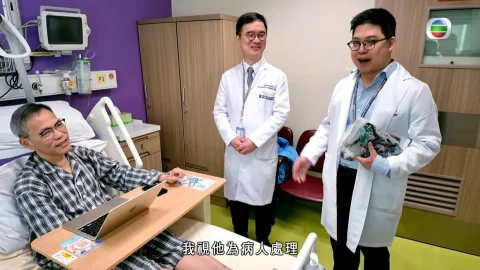



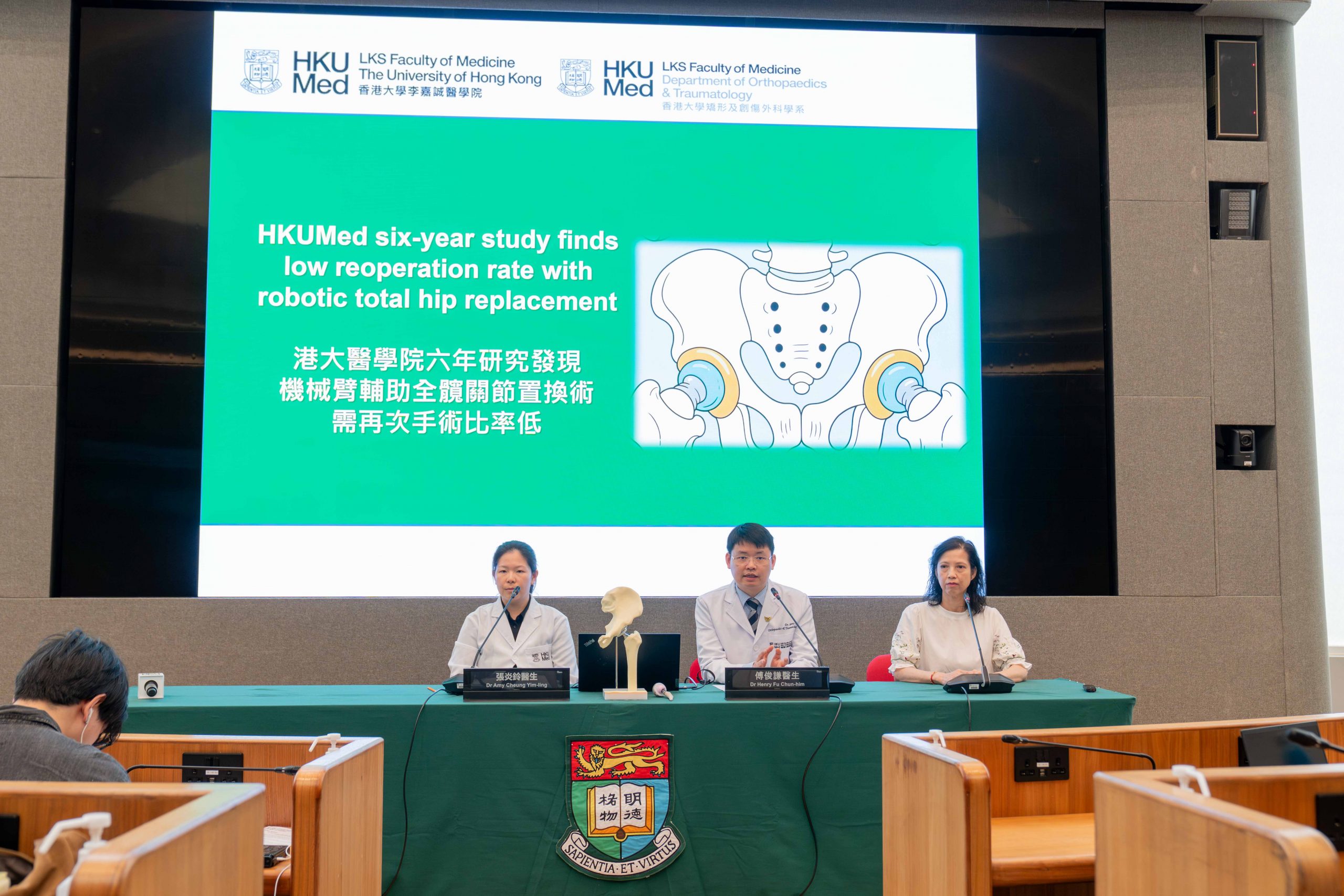
HKUMed six-year study finds low reoperation rate with robotic total hip replacement
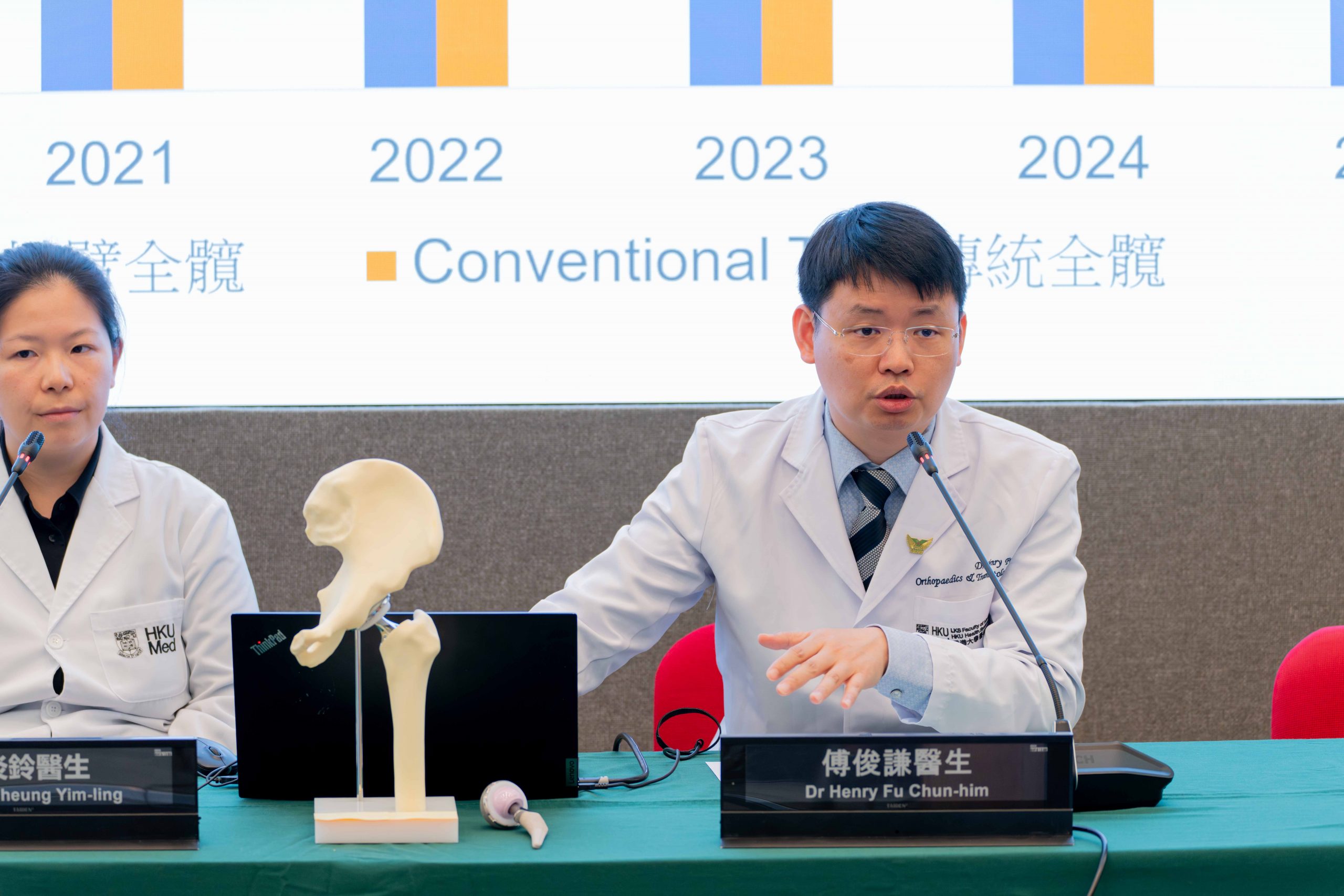
Professor Henry Fu
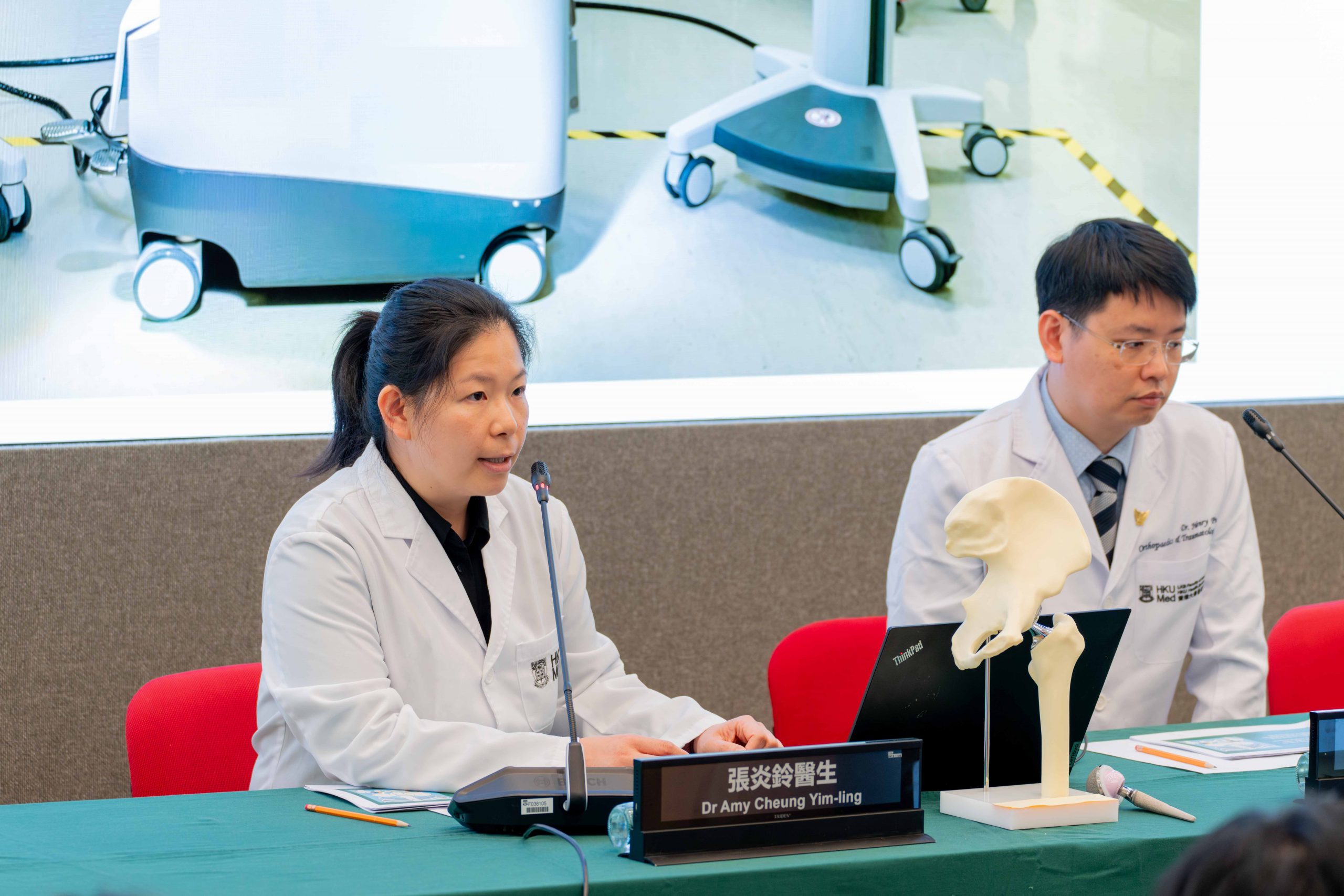
Dr Amy Cheung
Other Photos:
16 April 2026
A research team from the Department of Orthopaedics and Traumatology, School of Clinical Medicine, LKS Faculty of Medicine of the University of Hong Kong (HKUMed), has demonstrated that robotic total hip replacement has a lower reoperation rate than the conventional technique. The study found a 90-day reoperation rate of only 0.6% with robotic procedures as compared to 2.5% with conventional procedures. Robotic procedures thus promise long-term benefits for patients, enabling them to regain mobility and return to normal life.
End-stage hip arthritis causes severe groin pain, joint stiffness and functional deficit, including impairment in walking, sitting and standing. While total hip replacement is a common operation, complications can occur and may lead to reoperation and prolonged recovery times.
Precision in robotic arm assisted total hip replacement
Compared to conventional technique, robotic hip replacement utilises three-dimensional computed tomography scans for precise preoperative planning of both acetabular and femoral components. During surgery, acetabular bone preparation and implant positioning are carried out under robotic arm guidance, allowing for precise control over bone removal and cup placement.
Dr Henry Fu Chun-him, Clinical Associate Professor and Chief of the Division of Joint Replacement Surgery, Department of Orthopaedics and Traumatology, School of Clinical Medicine, HKUMed, said, ‘The robotic arm allows the direction and depth of the acetabular cup placement to be executed in accordance with preoperative planning, achieving angular precision down to 2 degrees and depth accuracy within 2mm.’
Six year local data confirms safety advantages of robotic hip replacement
The research team reviewed the results of 553 primary total hip replacement surgeries performed in Queen Mary Hospital and the Duchess of Kent Children’s Hospital at Sandy Bay Joint Replacement Centre between 1 January 2019 and 31 December 2024. These included 311 robotic total hip replacements and 242 conventional total hip replacements. The rate of reoperation within 30 and 90 days after surgery was lower for the robotic total hip replacement.
Dr Fu added, ‘Early reoperations after total hip replacement are devastating. With robotics, the rate of reoperation at 90 days is only 0.6%.’ In cases requiring reoperation in the robotic group, all procedures were done in a closed manner without the need for surgical reopening. In contrast, the conventional group had a 2.5% reoperation rate due to periprosthetic fractures and wound infections, requiring surgical reopening and resulting in prolonged recovery times.
While robotic procedures were associated with an overall increase in operative time of 14 minutes, the team observed a clear learning curve effect, with surgical times progressively approaching those of conventional manual procedures.
Growing utilisation of robotic surgery
HKUMed Department of Orthopaedics and Traumatology was the first in Hong Kong to utilise robotic arm technology for joint replacement surgery in public hospitals, beginning in January 2019.
Dr Amy Cheung Yim-ling, Honorary Clinical Assistant Professor and Deputy Division Chief of the Division of Joint Replacement Surgery of the same department, said, ‘The utilisation of robotics for total hip replacement in Queen Mary Hospital and the Duchess of Kent Children’ s Hospital at Sandy Bay has risen steadily from 32% in 2019 to 85% in 2025. In the local public sector, robotic procedures now account for 49% of total hip replacement surgeries.’
About the research team
The research was led by Dr Henry Fu Chun-him, Clinical Associate Professor and Chief of the Division of Joint Replacement Surgery, Department of Orthopaedics and Traumatology, School of Clinical Medicine, HKUMed. Other team members include Francis Fong, HKUMed MBBS student; and Dr Amy Cheung Yim-ling, Dr Michelle Luk Hilda, Dr Thomas Leung Ka-chun, Dr Lawrence Lau Chun-man, Dr Chan Ping-keung and Professor Chiu Kwong-yuen, all from the same department.
Acknowledgements
The research received support from the Tam Shiu Charitable Trust, to acquire the robotic arm assisted surgical system.
Related media interviews
More on:
港大醫學院六年研究發現 機械臂輔助全髖關節置換術 需再次手術比率低
2026年4月16日
香港大學李嘉誠醫學院(港大醫學院)臨床醫學學院矯形及創傷外科學系研究團隊證實,患者在機械臂輔助全髖關節置換術之後,需要再次進行手術的比率明顯低於採用傳統手術的患者,術後90天再次手術的比率僅0.6%,傳統手術為2.5%。研究顯示,機械臂輔助手術可望為患者帶來長期效益,讓關節置換效果更持久,助患者恢復活動能力,並重拾正常生活。
末期髖關節炎會導致嚴重的腹股溝疼痛、關節僵硬和功能障礙,影響患者走動、坐立困難。雖然全髖關節置換術是一項常見手術,但仍可能出現併發症,導致需要再次手術和延長復康時間。
精準定位:機械臂輔助手術的優勢
與傳統手術相比,機械臂輔助全髖關節置換術利用三維電腦斷層掃描(CT)進行術前規劃,就髖臼和股骨假體組件作出精準定位。手術中,預備髖臼骨和假體植入均在機械臂的輔助下進行,讓醫生能精準控制骨骼移除和髖臼杯放置過程。
港大醫學院臨床醫學學院矯形及創傷外科學系臨床副教授兼關節置換外科主任傅俊謙醫生表示:「機械臂能夠根據術前規劃控制髖臼杯的放置方向和植入深度,角度精度可達2度以內,深度誤差亦可控制在2毫米以內。」
六年本地數據證安全優勢
研究團隊回顧2019年1月1日至2024年12月31日期間,在瑪麗醫院和大口環根德公爵夫人兒童醫院的關節置換中心進行的553宗初次全髖關節置換手術的結果,當中包括311宗機械臂輔助全髖關節置換術和242宗傳統全髖關節置換術。結果顯示,機械臂輔助手術後30天和90天內需要再次進行手術的比率均低於傳統手術。
傅醫生說:「全髖關節置換術後若需要在短時間內再次進行手術,往往對病人造成重大的身心打擊。採用機械臂輔助,90天內再次進行手術的比率僅為0.6%。」研究發現,接受機械臂輔助手術的患者,進行再次手術時均以閉合方式進行,無需再次開刀。相比之下,傳統手術組別的再次手術率為2.5%,原因是出現人工關節周邊骨折和傷口感染,因此需要再次開刀,延長了康復期。
研究亦指出,機械臂輔助手術的整體手術時間平均較傳統手術多14分鐘,但研究團隊觀察到隨着經驗累積,手術時間會逐漸縮短,接近傳統人手操作的手術時間。
機械臂手術應用日益廣泛
港大醫學院臨床醫學學院矯形及創傷外科學系自2019年1月起,成為本港首個團隊於公立醫院採用機械臂技術進行關節置換手術。
同一學系的名譽臨床助理教授兼關節置換外科副主任張炎鈴醫生表示:「在瑪麗醫院和大口環根德公爵夫人兒童醫院採用機械臂輔助全髖關節置換手術的比例,已從2019年的32%逐漸上升至2025年的85%。在本港公立醫療系統中,機械臂輔助手術目前已佔全髖關節置換手術的49%。」
關於研究團隊
該研究由港大醫學院臨床醫學學院矯形及創傷外科學系臨床副教授兼關節置換外科主任傅俊謙醫生領導。其他團隊成員包括港大醫學院內外全科醫學士課程學生方紀樂;以及同一學系的張炎鈴醫生、陸曉恩醫生、梁家俊醫生、劉振民醫生、陳秉強醫生和曲廣運教授。
鳴謝
此研究獲得譚兆慈善基金資助,用以購置機械臂輔助手術系統。
相關媒體報道
更多內容